
Tracing the Canvas of Time: A Journey Through African Art History
African art history spans 77,000 years from Blombos Cave to Benin bronzes and Shona stone. Discover the timeline that shaped world creativity.
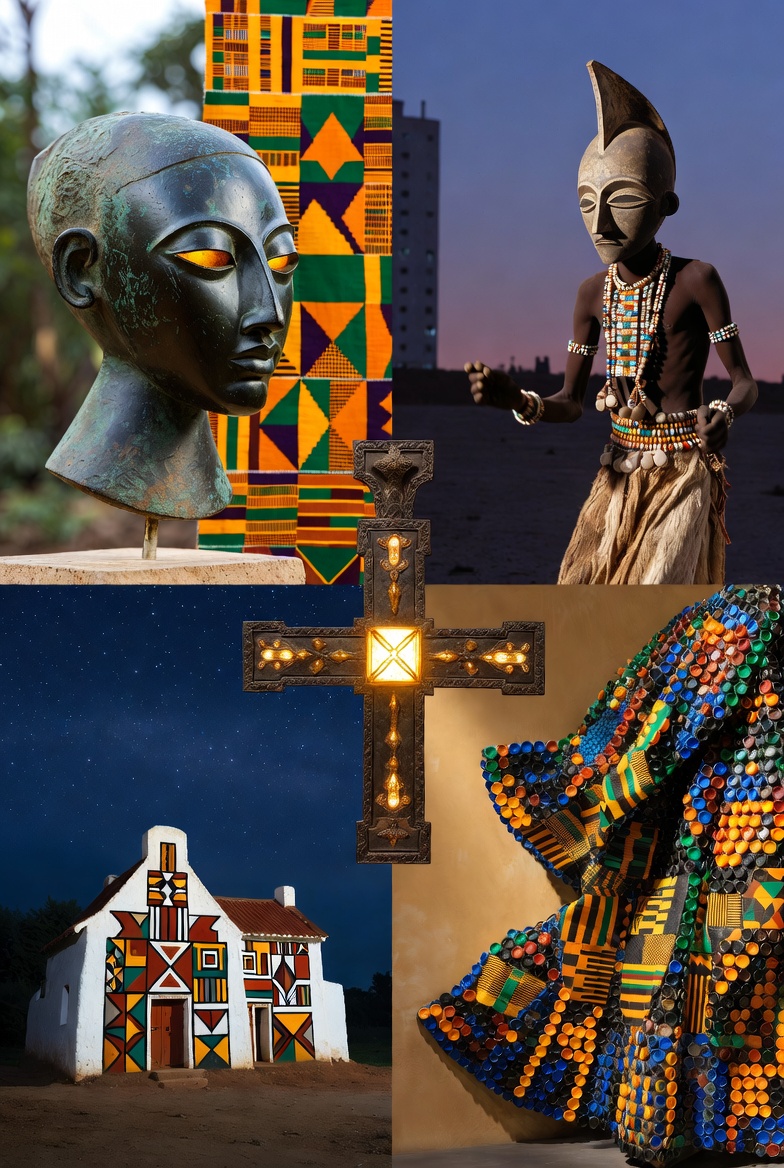
Feel the weight of a 77,000-year-old ochre crayon from South Africa’s Blombos Cave, its cross-hatched lines the first whisper of human creativity. Then fast-forward to a gleaming El Anatsui bottle-cap tapestry cascading down a New York gallery wall. African art history is not a footnote. It is the root system of global aesthetics, spirituality, and innovation. From the rock shelters of the Sahara to the bronze courts of Benin, from Nok terracotta smiles to Shona stone spirits, this timeline spans 54 nations and over 3,000 cultures. Whether you’re learning Swahili through Makonde carvings or planning a heritage tour in Mali, African art history rewrites the story of humanity.
Crafted from earth, metal, fiber, and imagination, African art served gods, kings, healers, and rebels. It birthed Cubism, Abstract Expressionism, and Afrofuturism. Let’s walk the timeline step by step, chisel by chisel.
The Dawn: Prehistoric Beginnings (77,000 BCE – 500 BCE)
Art begins with intention. In Blombos Cave, 77,000-year-old ochre blocks bear deliberate grids early abstraction. By 25,000 BCE, Namibia’s Apollo 11 Cave stones show animal paintings in charcoal and hematite. Sahara rock art (10,000–4000 BCE) explodes with life: swimmers in Libya’s Acacus Mountains, cattle parades in Algeria’s Tassili n’Ajjer.
Nok culture (Nigeria, 1000 BCE–300 CE) fires the first sub-Saharan sculptures life-size terracotta heads with triangular eyes, drilled pupils, and elaborate coiffures. These portraits hint at social hierarchy and spiritual power. Egypt’s pharaonic canon colossal statues, painted reliefs sets standards for monumentality by 3000 BCE. As UNESCO documents, Nubian pyramids and Meroë ironwork prove art flourished south of the Nile too.
Kingdoms and Courts: Classical Mastery (500 BCE – 1500 CE)
Trade and empire fuel sophistication. Ife (Nigeria, 1000–1400 CE) casts naturalistic zinc-brass heads with striated scarification portraits so refined they stunned European scholars. Benin Kingdom (13th–19th century) perfects lost-wax bronze: ivory-clad queens, leopard hunters, Portuguese traders immortalized on palace plaques.
Great Zimbabwe (11th–15th century) carves eight soapstone birds emblems of royal divinity atop granite walls. Kongo Kingdom nails nkisi figures with blades and mirrors to bind spirits. Mali Empire (13th–16th century) builds the mud-brick Djenné Mosque, its bundled piliers sculptural prayers to the sky. Swahili city-states (800–1500 CE) carve coral mihrabs and Chinese-inspired ivory siwa horns. Explore coastal trade’s impact in this Malegado guide to Swahili civilization.
Colonial Shadows and Resistance (1500–1960 CE)
Contact brings plunder. Portuguese raids strip Benin of 4,000+ bronzes by 1897 now scattered in London, Berlin, and Chicago. Missionaries brand masks “idols,” yet artists adapt: Fang reliquary figures hide in forests, Dogon carvers encode cosmology in granary doors.
Urban centers birth new forms. Oshogbo (Nigeria, 1960s) fuses Yoruba myth with expressionist painting under Susanne Wenger. Makonde “tree of life” carvings twist family into surreal ebony for export. Poto-Poto school (Congo) paints vibrant market scenes. Resistance art emerges: San rock paintings document colonial violence; Ndebele house murals defy apartheid uniformity.
Independence and Renaissance (1960–2000 CE)
Freedom ignites revival. Zimbabwe’s Shona sculpture movement (1966–) sees Frank McEwen mentor carvers like Henry Munyaradzi polished serpentine spirits now grace the MoMA. Senegal’s École de Dakar blends négritude philosophy with tapestry and sand painting. Nsukka School (Nigeria) revives ulu line drawing and nsibidi script.
Contemporary voices rise. Cheri Samba (DRC) paints comic-style social critiques. Magdalene Odundo (Kenya) coils burnished ceramics into global museum stars. Yinka Shonibare (Nigeria/UK) drapes Victorian mannequins in Dutch wax cloth to skewer empire.
The Global Now: Restitution, Markets, and Afrofuturism (2000–Today)
African art commands $100 million+ annually. El Anatsui’s bottle-cap draperies sell for $1.5 million. Njideka Akunyili Crosby’s layered paintings fetch $3 million+. Benin bronzes return home Germany handed back 22 in 2022.
Digital frontiers open. Kehinde Wiley reimagines Old Masters with Black subjects. Wangechi Mutu collages Afro-surrealism. Afrofuturist architects like David Adjaye design the Smithsonian NMAAHC as a bronze corona. As The Guardian reports, restitution debates reshape museum ethics.
Art preserves language: Adinkra symbols teach Akan proverbs; nsibidi encodes Igbo philosophy. It heals post-genocide Rwanda uses imigongo cow-dung panels for reconciliation.
Timeline Highlights at a Glance
- 77,000 BCE: Blombos ochre engraving
- 10,000 BCE: Sahara rock art
- 1000 BCE: Nok terracotta
- 1200 CE: Ife brass heads
- 1400 CE: Benin bronze plaques
- 1966: Shona sculpture workshop
- 2018: Macron pledges restitution
- 2023: Nigeria’s Edo Museum of West African Art breaks ground
Why African Art History Matters Today
It corrects Eurocentric narratives modernism didn’t start in Paris. It drives economies: Kenya’s art exports rival coffee. It empowers youth Lagos’ CCA trains 200 artists yearly. It fosters empathy: learning chi wara antelope symbolism via Bambara builds cultural fluency.
Tourism booms Djenné’s Monday market sells authentic bogolan cloth. Sustainability grows Shona carvers use reclaimed stone. Restitution heals returned Vigango memorials calm Kenyan spirits.
Your Roadmap: Study, See, Support
Start digital. Google Arts & Culture offers 360° Benin bronze tours.
Read Sylvester Ogbechie’s Making History: African Art in the 20th Century.
Sketch nsibidi signs.
Travel? Fly to Dakar’s IFAN Museum, sleep in Dogon cliff villages, bid at Cape Town’s Investec Art Fair.
Support ethically. Buy from Tengenenge (Zimbabwe) or Ardmore Ceramics (South Africa). Verify provenance via Artkhade. Pair with language French unlocks Poto-Poto archives; Portuguese reveals Angolan samba masks.
How Malegado Paints Culture into Language
Malegado makes art history your classroom. Study French to read Djenné inscriptions. Learn Portuguese for Kongo nkisi rituals. Tutors decode Adinkra in Twi. Forums share Shona polishing videos. Translate art terms across borders via our French-Portuguese translator guide. From virtual timeline walks to language-through-symbol lessons, Malegado colors your journey.
The Story Never Ends
African art history is a living scroll each Nok smile, each Anatsui fold, each Mutu collage adds a line. Start reading it on Malegado today. The canvas is vast, and the paint is still wet.