
Angkor Wat: Cambodia’s Timeless Wonder
Angkor Wat is Cambodia’s crown jewel, the world’s largest temple complex, and a living symbol of Khmer ingenuity and devotion. From Hindu origins to Buddhist sanctity, it’s a masterpiece that still inspires awe.
Introduction
Angkor Wat is not just a temple. It is Cambodia’s beating heart, a masterpiece of architecture, and one of the world’s most awe-inspiring cultural landmarks. Tucked within the tropical forests near Siem Reap, this ancient citadel attracts more than one million visitors every year, making it one of the most visited heritage sites in Asia. But its significance goes beyond tourism. For the Khmer people, Angkor Wat is a symbol of identity, resilience, and spirituality that has survived centuries of change.
The Origins of a Monument
Built in the early 12th century under King Suryavarman II, Angkor Wat was originally dedicated to Vishnu, the Hindu god of preservation. Unlike most temples of its era, which were oriented toward the east, Angkor Wat was constructed facing the west, often associated with Vishnu and symbolic of death, eternity, and the cycle of rebirth.
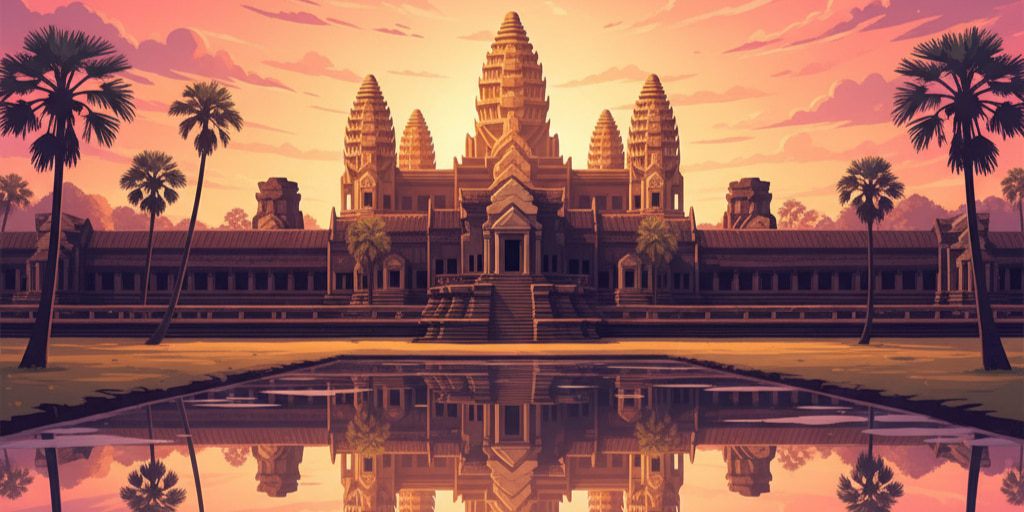
The temple was designed to reflect Mount Meru, the mythical home of the gods in Hindu cosmology. Its five lotus-shaped towers rise majestically above vast galleries and courtyards, each level symbolizing a stage of spiritual ascent. When viewed from afar, the harmony of its design mirrors both the natural order of the universe and human devotion.
A Shift Toward Buddhism
While conceived as a Hindu temple, Angkor Wat gradually became a major Buddhist site in the 14th century. Buddhist monks continue to inhabit and worship in its sanctuaries today. This transformation reflects Cambodia’s own shifting cultural and religious history, turning the temple into a living monument that bridges two great traditions: Hinduism and Buddhism.
Architectural Genius
Covering 162 hectares (about 400 acres), Angkor Wat is the largest religious monument in the world. Its construction is a marvel of engineering. Massive sandstone blocks, some weighing up to 1.5 tons, were transported from quarries nearly 50 kilometers away. The scale and precision of the temple’s bas-reliefs are unmatched.
The galleries feature over 800 meters of carved stone panels, illustrating Hindu epics like the Ramayana and Mahabharata. These reliefs depict cosmic battles, court rituals, and celestial beings, effectively turning the temple into a stone library of mythology and history.
Symbolism and Meaning
Every detail of Angkor Wat has symbolic weight:
- Five Towers represent the five peaks of Mount Meru.
- Moat Symbolizes the cosmic ocean.
- Central Axis Aligns with the stars and the solar calendar, reinforcing its cosmic significance.
Angkor Wat is not just a temple but a microcosm of the universe, a sacred bridge between the human and the divine.
Angkor Wat Today
Recognized as a UNESCO World Heritage Site in 1992, Angkor Wat has become a national symbol for Cambodia. It even appears on the national flag, a rare honor, showing how deeply the monument is tied to Cambodian pride and identity.
Tourism has grown rapidly, with more than a million visitors annually, drawn by the iconic sunrise view where the temple silhouette glows against a pink-orange sky. Yet, this influx raises questions of preservation. Overcrowding, humidity, and looting have placed stress on the fragile stonework. International collaborations are now working to restore and safeguard Angkor Wat for future generations.
Why Angkor Wat Matters Globally
Angkor Wat is more than Cambodia’s treasure; it belongs to the world. For historians, it is a window into the Khmer Empire, once one of the most advanced civilizations in Asia. For spiritual seekers, it is a living temple where centuries of prayers still resonate. For travelers, it is a once-in-a-lifetime destination that inspires wonder.
Its blend of architecture, religion, and astronomy makes Angkor Wat a universal story of human creativity, faith, and resilience.
Visiting Angkor Wat
Today, visitors often arrive at dawn to watch the sun rise over its lotus towers. Guided tours offer deep dives into its bas-reliefs, while the surrounding Angkor Archaeological Park reveals dozens of temples, each with its own story.
Practical tips for visitors:
- Best time: November to March (dry season).
- Entrance: A single-day pass is about $37, with multi-day passes available.
- Respect: As an active religious site, modest clothing is expected.